

 |
|
 |
 |
|
 |
 |
 |
 |
 |
 |
 |
CONFESSIONS OF THE WORLD’S MOST FAMOUS FAN |
 |
 |
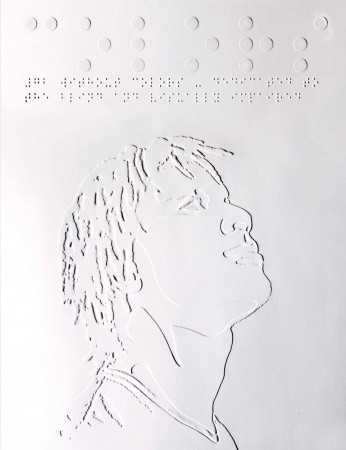
As close as you’ll get to a face to face with writer JT LeRoy.
Madonna. Bono. Winona Ryder. Debbie Harry. Tatum O’Neal. Marilyn Manson. Asia Argento. Lou Reed. Courtney Love. Liz Phair. Gus Van Sant... The list of JT LeRoy’s declared celebrity admirers stretches on and on (Shirley Manson of the band Garbage even wrote a song about him). But as much as the 24-year-old author, who lives in San Francisco, has a love-love relationship with his famous friends (artists who, in most cases, he contacted because he was a fan of their work), he also has a love-hate relationship with his own fame. The author of the books Sarah and The Heart Is Deceitful Above All Things—both of them critically acclaimed cult bestsellers that have been translated into at least a dozen languages and are being |
 |
|
 |
 |
made into movies—has already been the subject of a celebrity-style biography published in Italy and a Dutch documentary. And yet, he never permits himself to be photographed without first putting on a wig and glasses, or a mask—a ritual designed to preserve his anonymity, but one that also contributes to his reputation for being a literary version of Garbo or Warhol. COLORS talked to LeRoy about the genesis of his fandom—and his complicated relationship with his own fans.
COLORS: You haven’t been shy about revealing your own fandom. You’ve reached out
to a lot of writers to let them know how much you love their work. When did you start doing that?
JT LeROY: My therapist, who got me started writing, had an upstairs neighbor who was an editor. I met him and we discussed books and I told him that the poetry of Sharon Olds was the only poetry I could make sense of and that I loved it. This editor happened to be friends with Sharon and told me, “Well, I told her everything you said and she wants |
 |
|
 |
 |
you to write her.” I did, and she wrote me back.
That was the first time you wrote to
another writer as a fan?
Yeah, then we started writing back and forth. This was 10 years ago. I was addicted after that. I was like, My God, you can write to these people? It was like writing to Santa Claus and Santa actually writes back! So I went to the library and found out how you contact writers: you send a letter to their agent or publisher—there was this book in the library that said who those people were.
When you published Sarah, you put your e-mail address in the back so people could contact you…
It meant so much to me to have that communication. I answered every e-mail for almost two years until it got to be too much. But the idea that someone would write to me and not hear back was just painful to me. Then I found that there are a lot of people who get angry if you don’t write back—they decide that you think that you’re too good |
 |
|
MY GOD, YOU CAN WRITE TO THESE PEOPLE? |
 |
 |
 |
for them. And that turns into rage. Then you realize that love and hate are intertwined—that the impulse to worship you is often one step removed from wanting to tear you down. At first it’s adulation; then you do something wrong in their eyes and they want to fucking kill you.
Have you ever felt unsafe, like at your readings?
When I did my book tour in Italy, I needed a police escort to get around. I’d never experienced anything like that.
What was the crowd like?
People staring and handing me stuff, which is really nice. But there’s also this way, like, they just want to touch you. It’s a very fine line: I’m very honored by it, but at the same time it’s overwhelming and terrifying. When you’re a writer it’s not like you sit at home and dream of audiences applauding the way an actor does. |
 |
|
 |
 |
A lot of your fans, and certainly the press, are fascinated by your attachments to celebrities—rock and pop stars in particular.
You know, I’m very much into music, but I guess there’s this real line drawn between literary people and musicians. You don’t see a lot of writers hanging out with musicians, you know? Someone even told me, “If you want to be taken seriously, stop hanging out with rock-and-roll musicians.” But music is as important to me as books are. I grew up with my mother constantly playing music. Punk rock was a big part of my growing up. And the access to those people—like, if my mother liked a musician, she would go out and find him after a show and fuck him, you know? I’m just realizing this as I talk: I grew up with this idea that musicians were approachable. But there was also this idea that you had to give them something.
And so you’ve sent musicians your books.
Like with Billy Corgan [the former lead singer of the |
 |
|
 |
 |
Smashing Pumpkins, now lead singer of the band Zwan], I always felt that he would understand, that he would get my writing. You know, I think a lot of artists are supertasters.
What do you mean?
You know, scientists have found that there are people who have more taste buds, or more-attuned taste buds. An average person can eat a piece of cake, and go, “Ooh, that was good.” But a supertaster senses all those flavors that others can’t even imagine. So I feel artists are like that: they’re like supertasters with art. A lot of people will read a book and know it’s good, but supertasters will read between the lines and get this other stuff that’s the high-frequency stuff. And it gets really lonely unless you can communicate with other people that have that same pitch hearing, you know? I think that’s why a lot of artists hang out with other artists. |
 |
|
 |
 |
 |
LEFT: A LOVE LETTER SENT TO LEROY BY A FAN. |
 |
 |
 |
So your fandom of other writers and musicians had to do with wanting to potentially form relationships with like-minded people—
And I got addicted to it.
Then, at the same time, answering all those e-mails those first couple of years, you wanted to bond with non-supertasters, too. Average readers—your fans.
I think the more you can break down the walls, the better, but it’s hard, because no matter what, no matter how hard you try to say to people, “Look, I’m just a human being like you,” there are people who just have this kind of dazzle in their eyes. And then there are people who get really mad that you don’t make yourself theirs completely. Like, when I was in Milan, I did this reading, and there was this wall of paparazzi in front of the people who were there to hear the reading, and I was like, “Fuck this.” I thought, well, What would Andy Warhol do? What would the Sex Pistols do? What would I do? So I climbed under the table to read. |
 |
|
JOHN WATERS SAID TO ME, “THE MOST UN-AMERICAN THING YOU CAN DO IS REJECT FAME.”
|
 |
 |
 |
With a microphone?
Yeah, I took a microphone. All these paparazzi were there, holding their cameras, ready to shoot—but they’re pissed because they have to listen. There’s this whole proprietorship that people feel about people in the public eye. But I like not being seen. I like being able to walk outside and not be recognized. I’ve been with, like, Winona Ryder in public—people chase you down the street, and you get stared at.
That's why you're never photographed without a wig and glasses?
I like the anonymity in general. I guess an actor or an actress has the anonymity of thinking, “Oh, they don’t really know me, they just know the roles that I play.” But when you’re a writer, it’s like your essence comes through. I’ve had people say some inappropriate shit to me—right from my books. And I don’t want that thrown in my face. If you’re paranoid anyway, and that gets compounded by people actually |
 |
|
 |
 |
knowing intimate stuff about you, it’s pretty scary.
JT, you’re this total paradox, because you gravitate toward famous cultural figures—writers, musicians, actors—and your name has become a staple of the gossip pages of newspapers, but you can’t stand the idea of being recognized.
I know. I mean, I think some people are made for it and some people really thrive on it. But I’m not, I don’t. [The director] John Waters said to me, “The most un-American thing you can do is reject fame.” And I think if you don’t play out that fantasy the way people imagine you should, they get really mad at you: Okay, do you want fame or not? With me, I don’t completely reject it, but I don’t play it the way you’re supposed to. It’s like, you can’t give me enough fame. It’s like an alcoholic: one drink is too much and a million isn’t enough. I know that no amount of attention will ever fill my need for attention. And so I stay away from it because it cannot fill me, it cannot fix me. I’ve proven again and again, I cannot handle it. So I do it in a dose I can handle. |
 |
|
 |
 |
What’s the worst kind of fan?
A lot of people just feel that they don’t have any artistic gift to give and they wish they did. It’s those people who are like a moth to the flame. They need to be around fame. I think they’re probably artistic, creative people at some level, but they just don’t know how to express it, so they go for the lowest denominator: they’ll offer drugs. They’ll think, “Oh, this person uses drugs, or they’ve had a drug or alcohol problem, they’ll want to party with me.”
Fans offer you drugs?
Yeah. I can’t tell you how many people I meet—and even though I’ve talked about my drug issues, they’ll come up and offer me drugs, or sex. It’s like they want to have a connection, but feel like they don’t have anything else within themselves to offer. |
 |
|
 |
 |
That happens a lot to you?
I see it again and again and again. I think so many people are so separated from their artistic selves. I can’t tell you how many folks have said to me, “I don’t have an artistic bone in my body.” They just throw it off casually. I think people really crave having a voice, so they fetishize people who have found a way to have a voice. Art is powerful and it moves us. To me, artists are the face of God. I’m very moved by artists who have mastered their craft or are on a creative path—but I think society has confused artistry with anyone who has found a way to get their voice heard.
No matter what’s being said.
Yeah, no matter what that voice is saying.
Back to Table of Contents |
 |
|